

Sunday morning, it’s raining outside, and I find myself sitting in front of my laptop. Contemplating my note-taking structure and thinking about how to tweak and rebuild my system.
“Or maybe a different tool?”
But the last tools I tried? None of them really worked out for me. And none of them lasted for long. Just as I thought procrastinating had reached its limits, I found myself taking a note about why my note-taking always goes to hell.
But honestly, what more satisfying is there to do on a rainy Sunday? Equipped with good coffee and a few hours of quality time, I start my personal quest to resolve the puzzle of why my notes developed a life on their own.
“Let’s have a quick look at how I go from enthusiasm to frustration just within 6 weeks.”
Week 1–2 Dopamine peaks
I call it the honeymoon phase. Everything looks fresh and tidy. The new flavor is enough to give me a feeling of control and achievement without really having changed anything. Anyway, I feel like this time everything is set up in the right way. I have a clear structure, a clean interface, and my hopes are high.
“My dopamine is peaking.”
At this stage, there is nothing that can stop me; everything feels light. My ideas and thoughts just flow. I feel like a content creation machine. Understanding evolves faster than I can follow, and my notes accumulate faster than socks in my laundry.
Week 2–4 Friction rises
Okay, this is not rock bottom yet, but the first cracks surface. My notes are starting to outpace me. I blow further content into the rapidly filling balloon called notes-app. But my notes don’t shout back at me and tell me to slow down — they just execute my orders.
“With accumulating information and notes, the cognitive load also increases.”
My well-thought-out structure? Well, maybe it has some limitations? I thought I installed the backbone of my note-taking system, but now my structure feels rigid and energy consuming. I get the urge to tweak my system here and there. I drift into managing my system instead of managing my thoughts. Finding things becomes increasingly difficult. My enthusiasm starts to fade, and the structure that felt light in the beginning starts to create friction.
Week 5–6 The breakup
I know I have expected more from myself as well. But after only 6 weeks, the honeymoon phase finds an abrupt ending. The joy of opening my note-taking app is lost. How can something so meticulously built fail so quickly? The friction of the last two weeks has accumulated and turned into frustration.
“Effort and value drift apart.”
My note-taking system is now nothing more than evidence of how my structure and thinking have been overtaken and left behind. And before I was able to close the gap between my systems architecture and my skills, the balloon blew up. The day after the blow-up, I leave the parts aside and fill my quality time with something else. And a few weeks after, I will do a restart with a new tool
Why do I keep reaching the point where my note-taking system develops a life on its own?
“I pictured myself as an organized person and built a structure like I already am one.”
While writing this note, I keep scrolling back and forth through my notes. No specific goal in mind. Just mindlessly moving around without looking for something specific. I see similar notes with different structures, I see empty links and folders, I see a whole system that tries to fit content into a shaky scaffold. I think I was more building a structure than actually taking notes — loose ends appear everywhere. And my notes that don’t speak the same language, they didn’t get the attention they would have needed.
I started staring out of the window. After I came back, I looked through my kitchen, saw the coffee machine, looked at it for a while, and — I honestly don’t know why — stood up and went through my flat looking at all my stuff, and then saw my running shoes, which reminded me to go for a run today.
I ask myself: “What the hell am I doing?”
My digital life and my analogue life were two completely different worlds. My digital world was not built around my reality; it was built around someone I wanted to become.
It felt like I was not wearing my own running shoes in my digital world.
My note-taking system was based on a vision of myself, but not on my current reality and capabilities. I was more pretending to do things than actually making things happen. By creating a structure that focused on a future version of myself, I miscalculated that this implied a change in me as well. It’s like having the goal to run a marathon, but not setting up a training plan based on your current fitness level.
I think to myself, “You don’t run the fucking thing in 8 weeks if you struggle to run to the tram today.”
My vision needs to be in line with my current level of knowledge or fitness. If not, I will always try to keep up, but still feel behind. By not taking that into account, I created a gap in my system that constantly grew bigger with use. Instead of gaining simplicity, I lost control. And I got further away of simplifying things even though that was my initial intention.
“My system doesn’t make me the person I want to become; it only amplifies the person I’m right now.”
I love the illustrations of Liz Fosslien, and this one is just on point for my situation — my alarm was set at 07:00 AM, but I never got up before 08:00 AM.
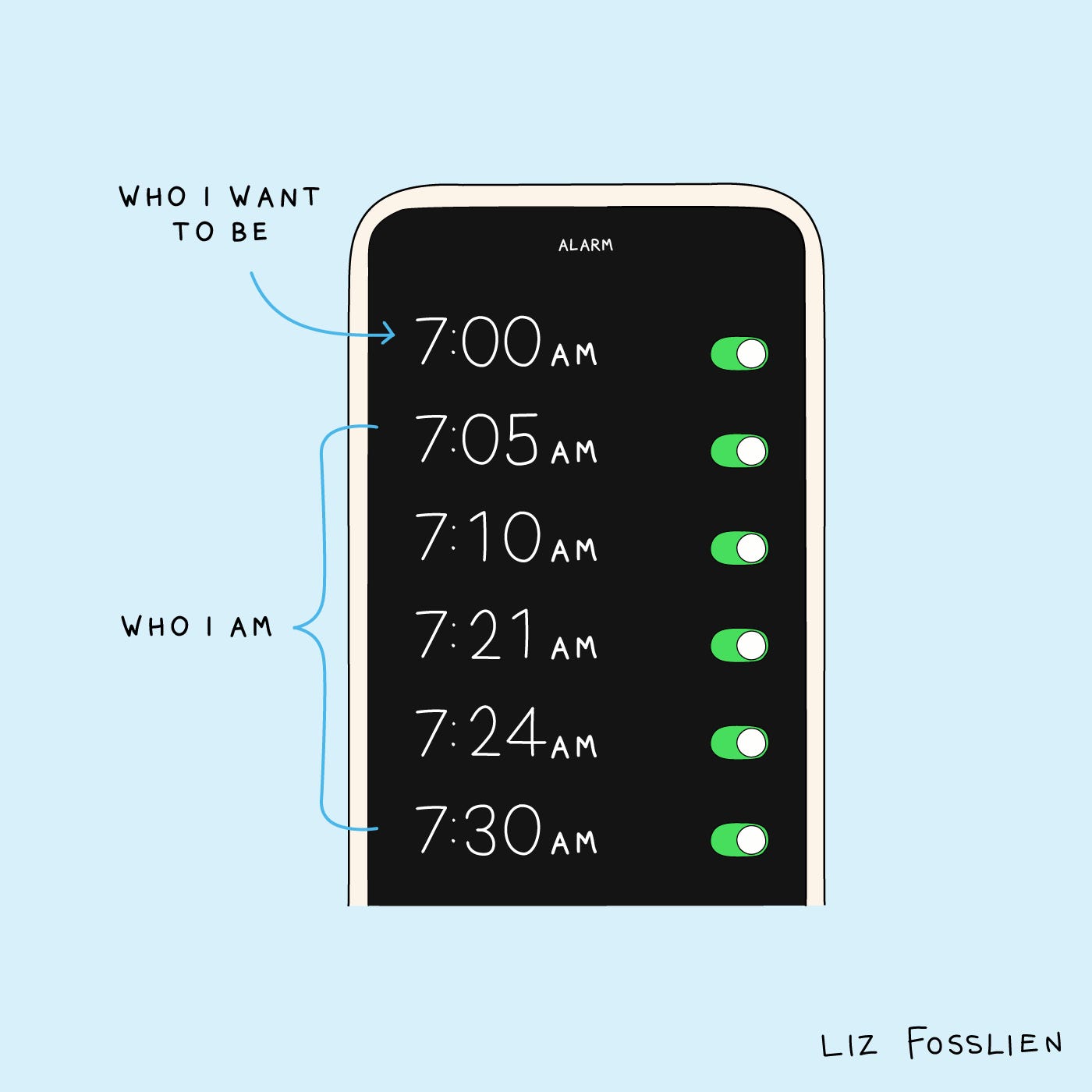
The reason for that was not that I was lacking willpower, but I simply had not set up a structure that would make getting up at 07:00 AM possible without feeling behind for the rest of my day. It is not only about the time of my alarm. It is about what happens before and after your alarm that makes getting up on time a true win. It’s not of any help if you stay up too long and wake up completely smashed.
In the case of my note-taking system, I thought structure would do the work for me, which basically means just setting the alarm at 07:00 AM and hoping for the best. But in reality, the structure didn’t do the work; it was rather distracting me from my core work. My focus was too narrow on getting the structure right — waking up at 07:00 AM — and at the same time not narrow enough for the details of my notes. I missed the part of interacting and growing with my notes.
To move from pretending I want to achieve stuff to actually making things happen, I needed to start building for the person I was at the moment — a note-taking system based on my personal inclinations, purposes, and capabilities. Simplicity in this case meant moving the right things in the background and letting other things step up. My structure had to move in the background to regain its strength and subtly lead me in the right direction. It is something that has to be earned and learned by trial, error, and adaptation. Simplicity evolves; only then can it earn its place and hold everything together.
For me personally, I always try to keep in mind that with every thing and every adaptation I make, it needs to simplify things in some way and not add friction somewhere else.
“So if I imagine myself in two weeks sitting in front of my laptop with some freshly ground coffee, what will have changed?”
I see myself at the exact same place in my kitchen, watching out of the window. The coffee today? Beautiful — even slightly better than last week. Already, the process seemed a bit more fun than usual.
In my mind, I’m already looking forward to writing down some thoughts. I don’t feel behind anymore; I feel in control of my notes.
Opening my notes app, I click “Add new note.” I will give it the title “How can I reduce decisions?” Afterwards, I will fill out my new minimal note structure: “Why”, “Notes”, and “References”. I will only fill out the notes with some bullet points and then go further to my next thought. As there is no need to answer the “Why” and “References” right now. This minimal structure is exactly what I need to make my notes work. Without it, there would be pure chaos. With too much, I would again drift into a premature and overbuilt structure. From now on, I don’t build on imagination; I build on actual needs. That’s a huge difference.
That approach simplifies my writing, simplifies my thinking, makes things easy to scan and easy to build up on. It’s mine, and it works.
There is no further structuring, no looking for where to place anything. Just thought after thought written down in my hub. The structuring part will follow in the next step, when notes have accumulated and when it feels right. Because I don’t need to be reminded of things that I love to do anyway. For me, it’s the right level of structure to neither feel lost nor limited.
“It gets me exactly where I want to be – in a flow.”
I also stopped sticking to rigid frameworks and instead started to build five main questions that work as purposes for my system. These purposes work as a filter for my note-taking system. Everything that is related to one of these topics goes into my system. The rest stays out. By having these clear boundaries, I gain clarity and prevent my note-taking system from collapsing. It is way easier to look over the notes for five specific purposes than to hold an overview of everything that accumulates randomly. Having a purpose for me means that on the first layer of my notes, I don’t have a broad topic like note-taking; I have something specific, like building my own knowledge system.
In the end, I close my laptop, put on my running shoes, and let my thoughts go wild. Afterwards, I feel confident. I gained trust in my minimal structure and notes. And I will take care that my note-taking system doesn’t start to get ahead of me. Finally, I feel like I’m not creating a second digital world — now both worlds speak the same language.